If you sit on a nonprofit board, you probably approve your executive director's pay once a year. You likely do it with the best of intentions and a modest percentage increase, and you rarely have the time to ask whether the number underneath that increase was ever right to begin with. Candid's newest compensation data is a good reason to pause and ask that question, because it suggests that for many women leading the nonprofit sector, the answer is no.
Key Takeaways
- Women nonprofit CEOs earn 73 cents for every dollar men earn, and that progress has stalled since 2021, with women holding just 31 percent of CEO roles at the largest organizations, where the gap has widened over the past decade.
- The gap grows from systemic forces, including negotiation dynamics, caregiving responsibilities, and unequal access to promotion, and it compounds over a career through percentage-based raises.
- Common board practices, such as benchmarking against underpaid peers or basing pay on what a leader asks for, can quietly carry these inequities forward.
- Fair executive pay starts with a thoughtfully chosen peer group and a market-based range, with placement based on experience, performance, and the true scope of the role.
- An independent, well-facilitated process protects both the organization and your relationship with your executive, and getting it right costs far less than getting it wrong.
What Candid's 2026 Report Found
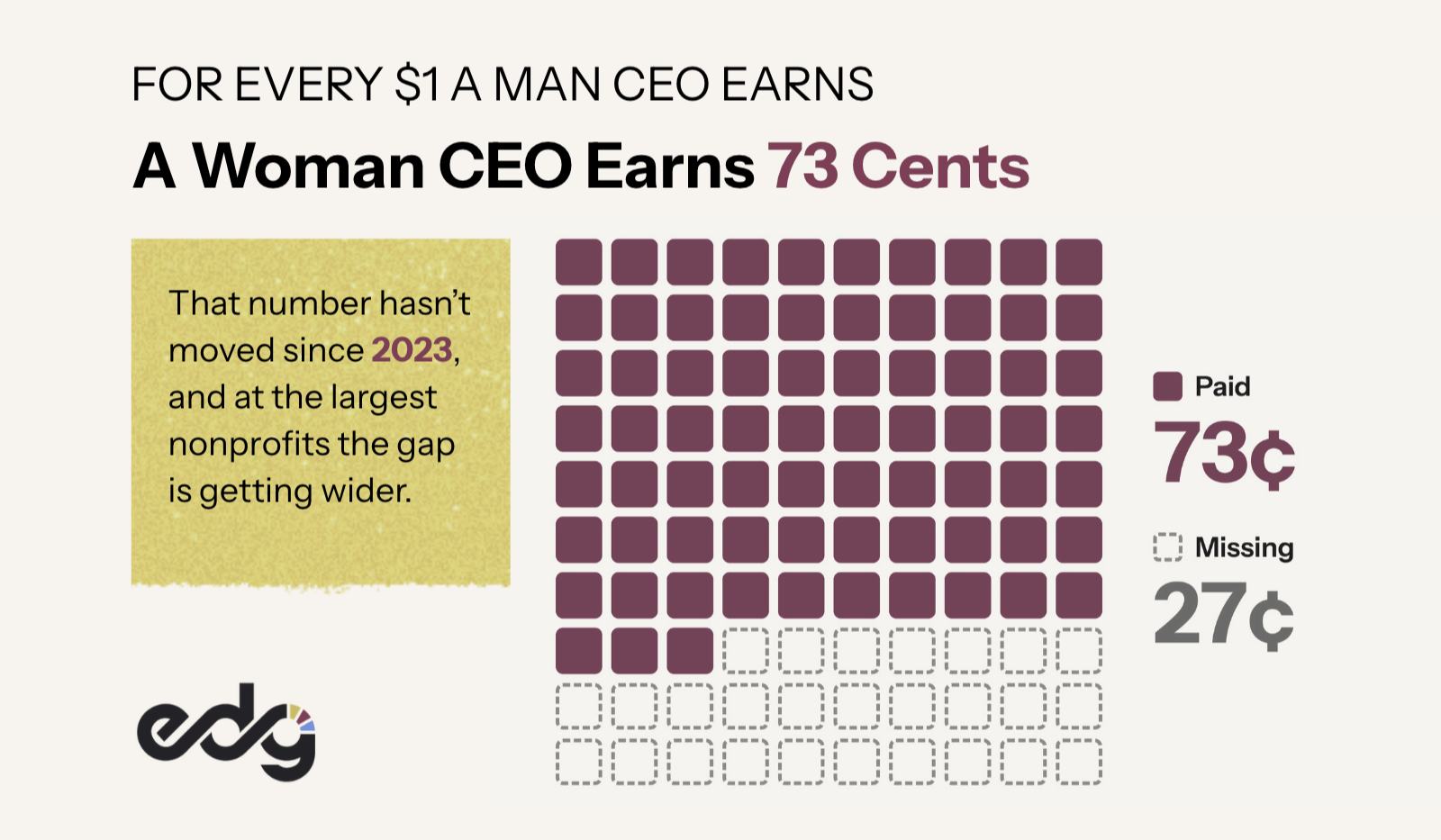
In August, Candid released its 2026 Nonprofit Compensation Report, which draws on 2024 IRS Forms 990 and 990-EZ filed by nearly 120,000 tax-exempt organizations and tracks salary and benefits across 14 executive positions. The headline finding is one that anyone who works in compensation will recognize: women CEOs earned 73 cents for every dollar earned by men in 2024. That is an improvement from 69 cents in 2014, but the progress has stalled since the figure first reached 73 cents in 2021, dipped to 72 cents in 2022, and has not moved since 2023.
The study shows the size of the organization matters a great deal in this story. At the smallest nonprofits, those with budgets under $250,000, women CEOs earned 96 cents on the dollar, and women hold between 58 and 62 percent of the top jobs at organizations with budgets of $500,000 or less. At the largest nonprofits, those with budgets over $50 million, the picture reverses, because women hold just 31 percent of CEO roles and earn 75 cents on the earned dollar of their male peers, which is actually down from 77 cents a decade ago. In other words, women are well represented where budgets are smallest, and both their representation and their relative pay fall away as the resources and the stakes grow. Part of that overall gap reflects women leading smaller organizations, which is its own equity concern, but the gaps persist even among organizations of similar size.
The sector leaders Candid interviewed echoed that concern. Aba Taylor of YW Boston urged boards to review executive pay through an equity lens, and Elizabeth Barajas-Román of the Women's Funding Network cautioned that gender is only one part of the picture, calling for analysis that also accounts for race, sexual orientation, disability, and geography, since a gender-only view can hide the deeper gaps facing women of color and leaders who hold multiple marginalized identities.
Why The Gap Persists, And Why It Should Concern Every Board
For those of us who work in nonprofit compensation, Candid's findings confirm what we already know.
A 27-cent gap is not the result of one bad decision by one board. It is the accumulation of systemic forces that show up long before a woman reaches the executive director's chair, and this is not a problem unique to the nonprofit sector by any stretch.
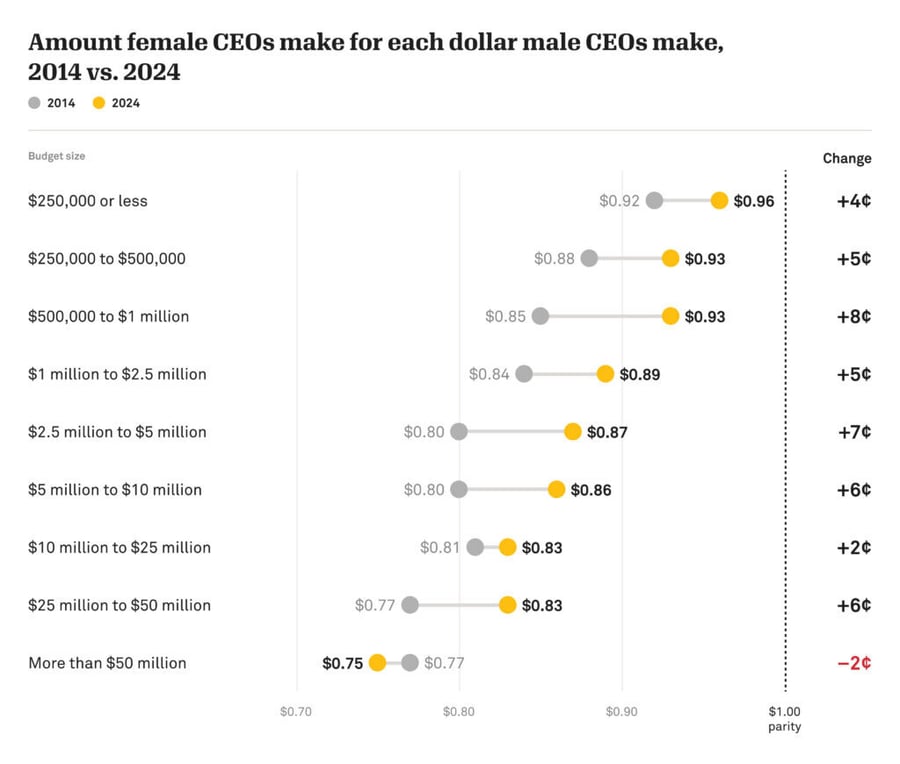 Source: 2026 Candid Nonprofit Compensation Report
The Gap Starts Early And Compounds Over Time
Negotiation is part of this story, though the research has evolved. Linda Babcock and Sara Laschever's 2003 book Women Don't Ask found that only 7 percent of women in one study negotiated their first salary, compared with 57 percent of men. Newer studies suggest the behavior has shifted but the outcome has not, since women graduating from a top MBA program between 2015 and 2019 negotiated more often than men yet were turned down more often and still earned less (Berkeley Haas), and a study of Australian workers found that women ask for raises as often as men but receive them less often (Newswise). Whether women hold back or speak up, the result too often lands in the same place, which is why fair pay cannot rest on an individual's willingness to ask.
That early difference does not stay small. Because most raises are calculated as a percentage of what someone already earns, a gap at the start of a career follows a woman up through every promotion, and it widens as it goes, since a percentage of a smaller number grows more slowly than the same percentage of a larger one.
Career paths play a role as well. According to a 2013 Pew Research Center survey, 42 percent of mothers had reduced their work hours to care for a child or family member, compared with 28 percent of fathers. Even when women stay fully in the workforce, many carry family obligations that leave little room for the stretch assignments that set someone up for advancement, and they are not always considered for promotions in the same way as their male peers. McKinsey and LeanIn.Org's 2025 Women in the Workplace report found that for every 100 men promoted to manager, 93 women are promoted, a gap that widens to 82 for Asian women and Latinas and to just 60 for Black women (LeanIn.Org).
A Long History Of Undervaluing Women's Work
The United States has spent decades underinvesting in work that has historically been done by women. Teachers and nurses are the obvious examples, and historically, many of the caregiving and community roles that the nonprofit sector grew out of were often volunteer positions, which meant many women were not paid for that work at all. The sector inherited that legacy, and the organizations doing the most mission-critical community work are often the ones that still pay as though that work is worth less.
Many Women Leaders Put Their Teams Before Their Own Pay
There is also something harder to measure, which is the expectation that women leaders will put everyone else first. We see it regularly in the executives we work with, many of whom instinctively go without a paycheck in tough times so that everyone else is taken care of. Those societal expectations shape where women set boundaries and what they feel comfortable asking for in terms of fair pay, and they make your role as a board in getting compensation right all the more important.
This is why the Candid data matters for your board, regardless of the leader you have in the seat today. Because Candid's analysis looks at gender alone, the gaps experienced by women of color and leaders with marginalized identities are likely wider than the headline number suggests, and a gap that has stopped closing tells us that good intentions are not enough on their own. Equity is not an add-on to executive compensation, and it needs to live in every step of the process.
The Work Behind Setting A Fair Salary
Setting executive pay is more of an art than a science, and the data is only the starting point. What follows is how we approach this work in partnership with boards, along with the places where we most often see well-meaning organizations reinforce a gap without realizing it, so that you can recognize them in your own process.
Choose Your Comparison Group With Care
IRS rules encourage boards to look at what comparable organizations pay for similar roles when setting executive compensation, which generally means benchmarking against reasonable peers of similar size, in a similar geography, that offer similar services. The specific requirements are worth reviewing with your own legal and tax advisors, and you can read the relevant regulation, 26 CFR § 53.4958-6, for yourself. A $10 million mental health provider should not compare itself to a $100 million organization or to an ed tech company, and an organization in the Bay Area should not be looking at peers in Oklahoma.
That is the floor, though, not the finish line. Compensation work can become an echo chamber, and here is how that happens in practice. Imagine you are the board of a $5 million early childhood education nonprofit, trying to set a fair salary for your executive director. The executive directors at your peer organizations are often disproportionately women, so if a wage gap exists in the market, you are now benchmarking your leader against a group of leaders who are already underpaid. It is an easy trap to fall into, because the data looks objective, but without a closer look it can quietly reflect the market's gap rather than a fair rate of pay.
Because executive compensation studies can draw on public 990 data, you have the ability to look more closely at who is in your peer group. You can ask whether you have a mix of leaders who are new to their roles and leaders with long tenure, and you can look at the gender and racial composition of the group, so that you build a diverse, community-aligned pool of peers that gives you a truer and more equitable sense of the marketplace.
Decide What Is Fair, Not What Someone Is Willing To Accept
We often use a simple comparison to explain the problem. Imagine walking into a restaurant, ordering your dinner, and having the server ask how much you are willing to pay for it, so that it falls to you to figure out what a fair price would be. That sounds absurd, yet it is essentially how most salary negotiations work, because organizations place the burden on the person joining them to advocate for a fair rate of pay, and many even make a lowball first offer to leave room for negotiation.
Now consider what that means for women. Whether women negotiate less, as earlier research suggested, or negotiate and are told no more often, as newer studies find, the result is that many end up accepting offers below market. And because so many people anchor their expectations on what they currently earn, the starting point itself is already uneven. Picture two candidates for the same role, one earning $100,000 and one earning $73,000, which echoes the scale of the gap Candid reported. Both walk in wanting to earn more than they make today, but they are anchored to very different numbers, and an offer shaped by those anchors can carry the market's gap into your pay scale without anyone intending it to, where it will compound with every percentage-based raise that follows.
This is why we encourage the organizations we partner with to consider a non-negotiation policy. To go back to the restaurant, it means telling everyone exactly what the meal costs and charging everyone at the table the same price, regardless of what they expected to pay. Your organization commits to not lowballing anyone and to leading with its best, fairest offer, which brings transparency and consistency to a process that too often rewards whoever feels most comfortable asking for more.
The same principle applies to executives already in the role. Questions like what a leader is asking for, what they are willing to accept, and what they currently earn are useful to know when you are planning how to communicate a decision, but they should not drive the decision itself. In the nonprofit sector, we often meet leaders who generously keep their own pay low so they can save the organization money and invest more in their team. That choice comes from a place of deep commitment, and it may help in the short run, but it also creates two risks. It sets a compensation ceiling that compresses the pay of everyone beneath them, squeezing the rest of the team's salaries into a narrow band below that cap, and it leaves the organization with an unsustainable financial model the day that leader leaves, because the next executive may not be willing to accept a reduced salary. Your board will have to address it eventually, so it is far better to address it now.
Start With The Market, Then Place The Person In The Range
Your goal should be to pay at least the market rate for the role, and to avoid being a market lagger, meaning an organization that consistently pays below the going rate for similar roles. Financial sustainability has to be a top priority, because a pay plan only works if the organization can sustain it, so if paying at market is not possible today, the first step is to build a strategy to get there over the next two to three years.
Once you understand the market and have built a salary range, the next question is where your executive belongs within it. That decision should rest on the leader's experience and performance, so a seasoned, high-performing executive should sit in the upper part of the range. This is also where an outside perspective is especially valuable, because an external consultant does not have a personal history with the individual or the anecdotal interactions that can quietly shape a board member's view.
Pay For The Job Your Executive Is Actually Doing
One of the most common situations we see is an executive who is effectively doing three jobs. When an organization does not yet have the right leadership team or supports in place, the executive director absorbs the gaps, often to save money or to protect their team, and women in particular tend to take on this kind of extra work. If your executive is now managing a larger team, a larger budget, a new function, or a larger fundraising goal, all of those changes should be reflected in their compensation, whether through base salary or through bonus and incentive pay.
This matters for succession, too, which is one of a board's fiduciary responsibilities. When an executive becomes a unicorn who has collected a hodgepodge of responsibilities that would not normally sit with the top role, the organization takes on real risk. We once worked with a client where a single staff member's job title was cheesemaker, communications lead, and archivist, and our first question was who the organization could possibly hire to replace that person. Building roles that make sense and align with the marketplace, and investing in a leadership team that shares responsibility, strengthens the organization's sustainability and also happens to be in the current leader's best interest.
For a closer look at how role clarity reduces burnout and strengthens succession, read Stop Designing Jobs Around People: How to Future-Proof Roles in Mission-Driven Orgs.
Keep The Process Independent, And Remember That It Is Personal
Many boards delegate executive compensation to a committee, such as the executive or compensation committee, and IRS rules offer guidance on how that process should work. It is a conflict of interest for the executive director to drive it. When we conduct an executive compensation study, we talk with the executive to understand what matters most to them and which organizations your organization tends to recruit talent from, but we build the final benchmark list with you, the board, and we present our findings and recommendations directly to you.
That conversation with the executive still matters, because a compelling package includes more than base salary and bonus. It is entirely appropriate to tailor elements like retirement, benefits, or deferred compensation to what is most meaningful to your leader, as long as the total value of the package stays aligned to the market.
It is also important to remember that so much of this work is emotional, because the conversation is about someone's worth, and your executive may not feel comfortable being fully candid with their own board about what matters most to them. An outside facilitator can create space for that honesty, and it often changes the outcome. In one study we conducted, the board had already decided to make a substantial investment in a high-performing executive who was being paid significantly under market. Part of the plan was a small incentive tied to a body of work that consumed a large share of the executive's time. In our conversations with the executive, we realized that even though the leader would have been thrilled with the total value of the package, the structure would have felt insulting, because it signaled that the board did not understand the true value of that work. We were able to help the board repackage the offer so that it resonated with the leader and left them feeling valued and recognized, and that difference was not visible anywhere in the benchmarking data. The more transactional this process feels, the more likely it is to create bad blood and leave a bad taste in the leader's mouth, even when the numbers themselves are generous.
The Data Is The Easy Part
We are always quick to point out that 990 data is publicly available and free, and that pulling it is not difficult, since anyone willing to sit down for an hour can gather it. The harder questions are whether you have chosen the right data set, how to age data that is often a few years old (that is, adjust older figures for the wage growth since they were reported), and how to translate it into a compelling, IRS-aligned package that you can communicate well.
Compensation is not something most people read about on the weekends, and there is real wisdom in knowing what you know and what you do not. When we need to navigate tax rules across several states, we hire an accountant, and when we build a marketing strategy, we bring in people who live and breathe marketing, even though we could probably muddle through on our own. Executive compensation belongs in the same category. The data itself is cheap and easy to get, but the decisions that follow involve real trade-offs, and that is where expertise and creative ideas can be invaluable.
We have worked with a client that received excellent market data from an analyst and then used it on its own to build a salary structure that, despite the team's best efforts, ended up working against them, giving entry-level roles the widest salary bands and executives the narrowest, even though executives typically need more room to grow in a role they may hold for a decade. The data was strong, but the consequences of how it was used will play out for years.
When To Bring In An Outside Partner
Not every board needs outside support every year, and many of the steps in this process are ones you can begin on your own. There are, however, moments when an independent partner can make a meaningful difference, both for the quality of the decision and for your relationship with your executive. You may want to bring in a partner when:
-
Your board has never conducted an executive compensation study, or it has been more than two to three years since the last one.
-
A long-tenured executive is preparing to retire, and you are unsure what the market will bear for their successor.
-
You do not have a clear picture of how your executive's pay compares with the market, or of how they feel about it.
-
Your executive's role has grown in team size, budget, fundraising goals, or responsibilities since their pay was last set.
-
Your executive has shared that they are unhappy with their compensation, although ideally you will reach out well before that conversation happens.
Getting the number right matters in both directions. The costs of overpaying an executive are easy to see, but the costs of underpaying are often larger and much harder to spot. Talented nonprofit leaders have options, and an executive who feels undervalued, or who is quietly insulted by how their pay is structured, may begin to look elsewhere, taking hard-won relationships and institutional knowledge with them. For example, in our experience, an executive compensation study typically runs between $10,000 and $15,000, a small investment relative to an executive salary that often falls between $150,000 and $250,000. Compared with losing a leader who feels undervalued, which can cost roughly $75,000 just to fill the role, that is not including costs associated with onboarding, training, and the disruption of a transition.
An outside partner can also have candid conversations with your executive that help you understand what matters most to them, so that the package you offer is not only fair on paper but also feels meaningful to the person receiving it.
Where To Start Before Your Next Compensation Vote
If you are a board chair reading this a month before your next compensation decision, start by understanding your current process. Many boards do not actually have a formal process for reviewing executive pay, and instead approve something like a 3.5 percent increase every year without revisiting the base. Before you decide what to pay your executive next year, make sure you can answer these questions:
1. What does your current process for setting executive pay look like, and who is involved?
2. How has your executive's compensation progressed over the course of their tenure?
3. How does your executive feel about their compensation?
4. How competitive is their total package compared with the market, and how was that peer group chosen?
If you cannot answer any of these questions, it is far better to find out now than after your executive has told you they are unhappy, because by then you are repairing a relationship rather than strengthening one. A loyal executive who has been underpaid for years and then sees their job posted at a far higher salary may feel deeply hurt at exactly the moment you most need their support for a smooth transition.
Think of executive compensation like dental hygiene. Boards that revisit their pay structures every two to three years as a matter of good governance are like the patients who floss regularly and never miss their annual check-up, so when they sit down in the chair, there are rarely any surprises. Boards that have not taken a close look in five years or more are more like the patient who has been putting off that appointment, and they may be facing a shocking (and likely expensive) discovery once someone finally takes a look. Wherever your board falls on that spectrum, knowing where you are starting helps us understand what we might uncover together, and reaching out is the right first step.
The most important lesson for boards in Candid's findings is that getting executive compensation wrong is far more painful and expensive than investing in a process to get it right. Your talent practices should reflect the communities you serve and the future you are building, and that starts with how you pay the person leading your mission.
Ready to talk through your executive compensation process? Whether you are preparing for your next compensation vote, planning for a leadership transition, or simply want us to show you how to pull free 990 data for your peer organizations, we would love to be a thoughtful partner in designing a fair, equity-centered approach. Contact our team at Edgility Talent Partners to start the conversation.
Download our free guide, Board Governance for Nonprofits. This practical guide walks boards through executive compensation, CEO performance management, and leadership succession planning, so that you can lead with clarity rather than urgency when leadership decisions matter most.