




You’ve done the hard work: you engaged staff, wrestled with tradeoffs, and built a talent management system that actually reflects your organization’s goals and values. Now the question is how to roll it out in a way that builds trust rather than anxiety, and clarity rather than confusion.
Success here is less about unveiling a new form and more about driving employee engagement by helping staff understand the benefits of talent management and experience the program as a supportive scaffold for developing the organization’s talent, rather than a compliance exercise.
Table of Contents
1. Start With the Story, Not the System
2. Sequence Matters: Rollout as Order of Operations
3. Equip People Managers First
4. Build Real Support Tools: FAQs, Toolkits, and Reference Materials
5. Decide: Pilot First or Roll Out All at Once?
6. Make It Ongoing: Onboarding, Performance, and Compensation
7. Create Spaces for Questions: Office Hours and Q&A
8. Build Feedback Loops: Learn and Refine Over Time
8. Don’t Skip the Disparate Impact Lens
9. Connect to Change Management Practices
10. From Talent Systems to High-Performance Culture
Start With the Story, Not the System
Many leaders want to jump straight into the mechanics of performance management: ratings, timelines, forms, and tools. But a talent management program lands well when people first understand the story behind it—why this, why now, and why this way?
The first place to start is by anchoring people in your philosophy: what you believe about employee performance, growth, and equity; the north stars that guided the design; and how this program will advance your culture and strategy over time.
Consider framing your narrative using the structure below:
- Why did you do this work (pain points, aspirations, equity commitments)
- How you approached it (inclusive, data-driven process, stakeholder input)
- What your guiding principles are (fairness, clarity, consistency, development)
- How it will be used (decisions it will shape, behaviors it will reinforce)
- When things will happen (timelines, milestones, when staff will feel it)
This framing makes clear that you didn’t build the program in a vacuum; it shows how team members' voices shaped the final program and positions the system as a thoughtful response to real needs.
Once people can see the “why” and “how,” they’re more open to the “what.” That shared context is what builds trust.
Sequence Matters: Rollout as Order of Operations
Think of implementation as a deliberate order of operations rather than a single announcement. You’re not just sharing information; you’re building understanding and capacity at each layer of the organization so leaders can carry the message with confidence.
For many organizations, the sequence looks something like this:
- Executive team
- Human Resources / People team
- People managers
- Full organization
At each step, you share the narrative and philosophy, walk through the design and practical implications, field questions, surface concerns, and capture those questions to strengthen your FAQ and toolkits. By the time you reach your full-staff rollout, you want as few surprises as possible—for you and for your managers.
If your organization is smaller and doesn’t have all these stakeholder groups, you simply skip steps. The goal is to build understanding one layer at a time.
Equip People Managers First
That’s why it’s so important to start with people managers and give them more than a quick overview. You’re asking them to bring this change into the heart of their work—performance conversations, calibration sessions, and recommendations about salaries and promotions. They need time to see the full picture, ask hard questions, and practice the story before they’re in front of their teams.
Often, that means bringing managers together for training where you walk through the messaging, the design, and what this will look like day to day.
In that space, they can ask: “How will this actually show up in my one-on-ones?” “What do I do if I don’t agree with a rating from last year under the old system?” or “How do I explain this without creating fear?” The goal is for them to have processed it enough to stand in front of their teams with confidence.
So instead of relying on a one-time slide deck, give managers:
- A clear, in-depth training that walks through the story, structure, and day-to-day implications
- Scenario-based practice (“What would you say if…?”)
- Strong reference materials they can revisit and share
- A robust, living FAQ written in manager-friendly language
- Toolkits with sample scripts, timelines, and checklists
- Space in the training to raise their own concerns and name the questions they expect from staff
Give managers space not just to receive information, but to work through how it intersects with their teams: where they anticipate confusion, where they see excitement, and where they may need coaching themselves.
Build Real Support Tools: FAQs, Toolkits, and Reference Materials
A talent management program touches many moments across the employee lifecycle: talent acquisition and hiring, goal setting, mid-year check-ins, promotions, salary decisions, and exits. That’s too complex to live in a single slide deck or policy document.
Create a set of practical tools that leaders and staff can return to:
- A plain-language FAQ that answers questions managers could get
- A visual overview of the talent management cycle across the year
- One-pagers on key components (competencies, ratings, calibration, employee development, development programs, high-potential identification, workforce planning, and succession planning). These tools should help you identify and support future leaders, not just document past performance.
- Short guides for “how to have this conversation” for managers and their direct reports
It’s important to remember that this content bank won’t be built in one sitting. You build it as you go. Each time you meet with executives, HR professionals, managers, or staff, capture new questions and skill gaps, and refine your materials. Over time, the FAQ becomes a record of your organization’s learning, not just another policy attachment.
This is one way to begin operationalizing equity. Without shared reference points and documentation, decisions default to whoever can advocate the loudest, happens to be in the room, or has connections to upper management. Clear, accessible tools are part of your equity infrastructure and create a more consistent foundation for decision-making about roles, performance, and pay.
Decide: Pilot First or Roll Out All at Once?
Introducing a talent management program is also about managing change, and change lands more smoothly when you’re honest about whether you’re in “pilot and learn” mode or “this is the new way” mode. That’s why the organization needs to decide whether to pilot the program (or its components) with a particular team, department, or level of staff, or to launch it across the entire organization at once with stronger upfront training and support.
Piloting is especially powerful when the program represents a major shift, when you’re introducing new concepts like competencies or performance metrics, or when different teams may experience the changes differently. A thoughtful pilot lets you spot confusing language or clunky steps, see how to streamline and optimize the program in real career development conversations, and identify early champions who can speak credibly to benefits and challenges. Then, when you expand beyond the pilot group, you’re not introducing a theoretical process—you’re sharing something that has already lived in your organization’s context.
If you opt for a full, all-at-once launch, be explicit about why. Even then, you can adopt a “phase and refine” mindset: roll out now, then intentionally revisit after the first full cycle.
Make It Ongoing: Onboarding, Performance, and Compensation
One of the most common pitfalls is treating the rollout of the talent management strategy as an event. You do the all-staff meeting, send the email, host a Q&A, and then move on. Six months later, new hires have never heard the story, managers have defaulted to old habits, and the talent management process feels like a disconnected requirement.
To make this system real, you need to thread it into recurring touchpoints:
- Onboarding: Every new employee should receive the same narrative and explanation as those who were present at the initial launch. This becomes part of how you welcome people into your culture and expectations.
- Performance cycles: Before the performance review season, revisit the talent management philosophy, competencies, and expectations. Remind people how the process works, what “good” looks like, and how career paths are defined and discussed.
- Compensation and salary setting: When you enter salary planning, return to your talent and compensation philosophy. Connect how performance, role expectations, market data, and equity considerations come together to shape decisions.
Each time you hit a key moment in the year, you’re not reinventing the message; you’re reinforcing it in context. Repetition, especially when tied to real decisions, is what shifts a talent management program from “a new HR thing” to “this is how we do things here.”
Create Spaces for Questions: Office Hours and Q&A
No matter how clear your training programs and materials are, people will have questions—edge cases, worries, and stories from past experiences where performance systems were weaponized or pay decisions felt opaque.
Build structured spaces for open dialogue: open office hours with the HR department or an executive sponsor, role-specific Q&A sessions, and anonymous question forms. These spaces give you real-time signals about where the approach isn’t landing as intended. You may discover that the way competencies are framed isn’t resonating, or that staff don’t see how career growth opportunities and internal mobility connect to performance ratings.
When you respond transparently—and update materials accordingly—you show that the program is built on informed decisions and that the organization is committed to stewarding it. That’s a key ingredient of an equity-centered approach.
Build Feedback Loops: Learn and Refine Over Time
A well-designed talent management program is not a one-time project; it’s a living system that depends on continuous learning. Once you’ve rolled it out and people have worked within it for a season or a full cycle, you need to pause and listen.
Gather feedback from multiple perspectives:
- Staff: How is this landing? Do they understand expectations? Do they see a fair connection between feedback, growth, and opportunity?
- People managers: Does the program help them be clearer, more consistent people leaders—or does it add confusion or administrative burden?
- Executive team: Is the program helping to advance the organization’s goals, strengthen culture, ensure employee retention of top talent, and surface the information they need to lead responsibly?
- HR Department/People team: Is it amplifying the overarching talent strategy and culture?
You can use surveys, focus groups, interviews, or a combination of these. The point is not to ask, “Do you like it?” but rather, “How is this helping or hindering your ability to do your best work and be treated fairly?”
Then, be explicit about how you’ll act on what you hear. Even small adjustments like clarifying language, simplifying a form, or adding additional mentoring training to upskill managers demonstrate that you are in an ongoing relationship with this program, not just enforcing it from afar.
Don’t Skip the Disparate Impact Lens
Many organizations are thoughtful about equity in the design of their people systems, but stop short of asking: who will this help, and who might this unintentionally harm?
This is where a disparate impact analysis comes in. Before fully committing, ask, “If this had been in place for the last one to two years, how might our decisions have impacted our staff differently, and for whom?”
Imagine how ratings, growth opportunities, promotions, and salary increases would have landed under your new system. Consider whether certain roles or departments might consistently receive higher ratings, or whether particular groups of staff might be more likely to access development opportunities or pay increases.
Then look for patterns that correlate with identity, such as race, gender, disability status, or other marginalized identities, that could uncover some groups that would be systematically advantaged or disadvantaged.
Approach this much like a wage equity analysis: retroactively apply your new framework to past data, see how outcomes would have shifted, and note where those shifts align with personal identity. If you see concerning patterns, it’s a sign to refine the design, strengthen manager training, or build additional safeguards into how decisions are made and reviewed.
Equity requires structure, and it also requires checking that your structure is working in practice, not just on paper.
Connect to Change Management Practices
Underneath all of this is change management and an evolution in how you approach performance. You are inviting the organization into a new way of talking about performance, development, and value. Many change frameworks emphasize similar themes: building urgency, crafting a clear vision, engaging key stakeholders, and reinforcing change over time.
When you step back and look at your rollout, you can see how closely it maps to these ideas. You’ve clarified the “why” and the stakes for your mission, built a guiding coalition across executives, HR functions, and people managers, communicated a clear vision backed by real tools, and planned for both short-term wins and long-term refinement.
This lens helps leaders see the implementation not as an isolated HR initiative, but as part of a broader culture shift toward clarity, fairness, and shared accountability.
It reframes the talent management solution from “rolling out a process” to “shaping how we make informed decisions about people,” which is where change management and equity both truly live.
A Simple Visual to Anchor Your Team
It can help to think of your rollout as a clear, step-by-step sequence:
- Define the Philosophy and Story: Articulate “why, how, what, when.”
- Executive Team: Receive narrative, ask questions, align on sponsorship.
- HR / People Team: Deep dive, refine tools, plan supports.
- People Managers: Training, FAQs, scenarios, and practice.
- Organization-Wide Rollout: All-staff meeting, resources shared, Q&A.
- Ongoing Integration: Onboarding, performance, compensation, office hours.
- Feedback and Disparate Impact Analysis: Surveys, focus groups, data review, refinements.
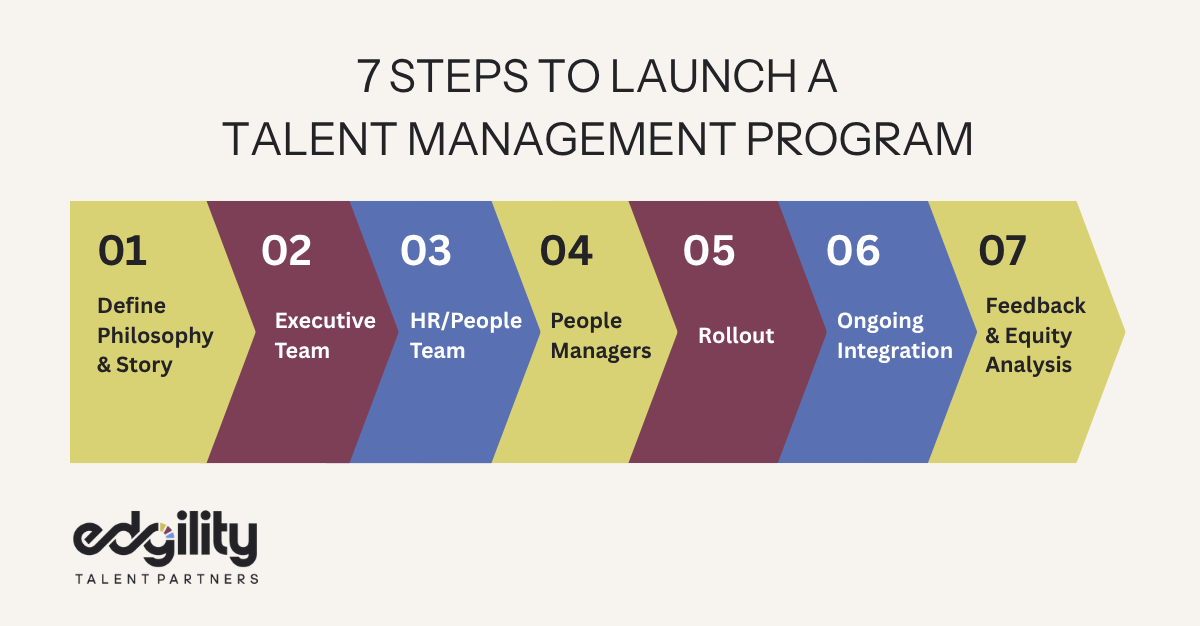
This sequence can serve as a touchstone alongside your narrative, a quick way for leaders and staff to see where you are now and what comes next.
As you plan or refine your rollout, you might ask:
- Where does our narrative feel strong, and where is it still vague?
- How prepared are our managers not just to execute the mechanics but to hold fair, honest, growth-oriented conversations?
- What feedback mechanisms and equity checks are in place to help us see how this really lands across different groups of staff?
From Talent Systems to High-Performance Culture
Rolling out a talent management program with this level of care is a powerful way to align your people systems with the culture you’re trying to build, but it’s only one piece of the puzzle.
If you’re ready to go deeper into what a high-performing workplace looks like in an equity-centered organization, how to clarify expectations, and how to build feedback and growth into the fabric of your culture, explore our resource High Performance, Shared Purpose: A Leader’s Guide to Building the Culture Your Mission-Driven Organization Needs.




-1-2-1.png "Untitled design (20)-1-2-1")