



Organizations tend to view succession planning like a fire extinguisher—something they know they should have, but rarely prioritize or think about. That is, until the stove catches fire and it suddenly becomes urgent, visible, and essential.
It makes sense. Mission-driven leaders are already carrying immense responsibility: navigating funding uncertainty, supporting staff needs, meeting board expectations, and keeping essential programs running for the communities that count on them. Nobody wants to add "plan for my own departure" to that list, especially when it means sitting across from a board and saying, " Let's talk about what happens when I'm gone.” That conversation implies you're thinking about leaving. It surfaces vulnerability most leaders would rather not name out loud.
So succession planning becomes buried beneath immediate needs that continually take precedence.
One client came to us after experiencing exactly this. Their executive director had led the organization for a decade and was deeply embedded in its operations. Every major funder relationship, government partnership, and connection with senior staff ran through that one leader. Then, the executive director departed suddenly and unexpectedly.
Within two years, the organization had accumulated $1.8 million in debt and lost a third of both its staff and program participants, including students and families who had placed their trust in its work. When we reviewed the strategic plan and mapped a realistic path to recovery, we estimated that it would take approximately five years to rebuild. That meant five years spent undoing damage that thoughtful succession planning might have prevented entirely.
Table of contents
1. Why Nonprofit Executive Succession Planning Must Begin Before a Leadership Transition
2. The Organizational Risks of Operating Without an Executive Succession Plan
3. What Should an Executive Succession Plan Include?
4. Why Nonprofit Boards Delay Succession Planning
5. How Succession Planning Strengthens Leadership Development and Retention
6. Executive Succession Planning Belongs on the Board’s Agenda
Why Nonprofit Executive Succession Planning Must Begin Before a Leadership Transition
Here's the hard truth about succession planning: by the time you realize you need one, you've already missed the window. A real succession plan takes years to build well—years of developing internal talent, clarifying leadership competencies, and identifying who's ready and who needs more runway. If you're trying to build that infrastructure the week after your executive announces they're leaving, you're not planning. Rather, you're reacting under pressure with limited options.
And yet, most boards of directors may never raise the subject, assuming their leader will stay indefinitely and are uncomfortable considering what would happen if they left. Leaders don't raise it either, because it feels awkward in a way that's hard to shake. The unspoken fear is that if a CEO puts succession planning on the agenda, the board will read it as a signal they're planning to leave. The inverse is also true: if the board of directors adds succession planning to the agenda, the CEO may misinterpret it as a sign that the board is preparing to replace them. So the conversation gets quietly shelved. The plan never gets built. And the organization coasts on the implicit assumption that the leader is staying, healthy, engaged, and indefinitely available—until they're not.
This is risk management. Full stop. Organizations need succession plans to mitigate leadership risk in the same way they develop scenarios for fundraising uncertainty. If your organization depends on two or three major funders, you should have a plan for what happens if one withdraws support. Leadership succession is no different. The test is simple: consider what would happen if a critical leader walked out tomorrow. If the thought makes you break out in a cold sweat, that is your answer.
The Organizational Risks of Operating Without a Succession Plan
The consequences of an unplanned leadership transition rarely remain contained within one area of the organization. They spread quickly, beginning with the organization’s ability to fulfill its mission. Whatever community you exist to serve or protect—people, families, students, animals, land, ecosystems—when your leadership destabilizes, your ability to show up for them deteriorates. Programs lose consistency. Participation drops. The work you've built over the years starts to fray at the edges because the people responsible for holding it together are instead managing a crisis.
Then there are the relationships that exist because your leader built them, not because they formally belong to the organization. Major funders and donors can be loyal to a person before they're loyal to a mission. Government relationships are among the most fragile in the sector: years in the making, built entirely on trust, and not the kind of thing that survives a rough handoff. Lose the leader without a thoughtful transition plan, and those relationships often walk out the door with them.
Inside the organization, a different kind of damage unfolds. Staff morale fractures and staff start quietly asking whether they still recognize the organization they chose to join. If emerging internal leaders have spent years developing their skills and preparing for an opportunity, seeing the organization rush to hire externally without seriously considering them may lead some to leave. Not because they object to the new leader, but because the process signals that their own growth and contributions are not valued.
Underneath all of these challenges is a subtler, structural problem: institutional knowledge trapped in a single person. When decision-making authority, organizational memory, funder relationships, and strategic vision all live in one place, the organization is one unexpected departure away from collapse. An executive succession planning process forces leadership to distribute and delegate through cross-training—not because anyone is leaving, but because no mission-driven organization should ever be that fragile.
What Should a Nonprofit Succession Plan Include?
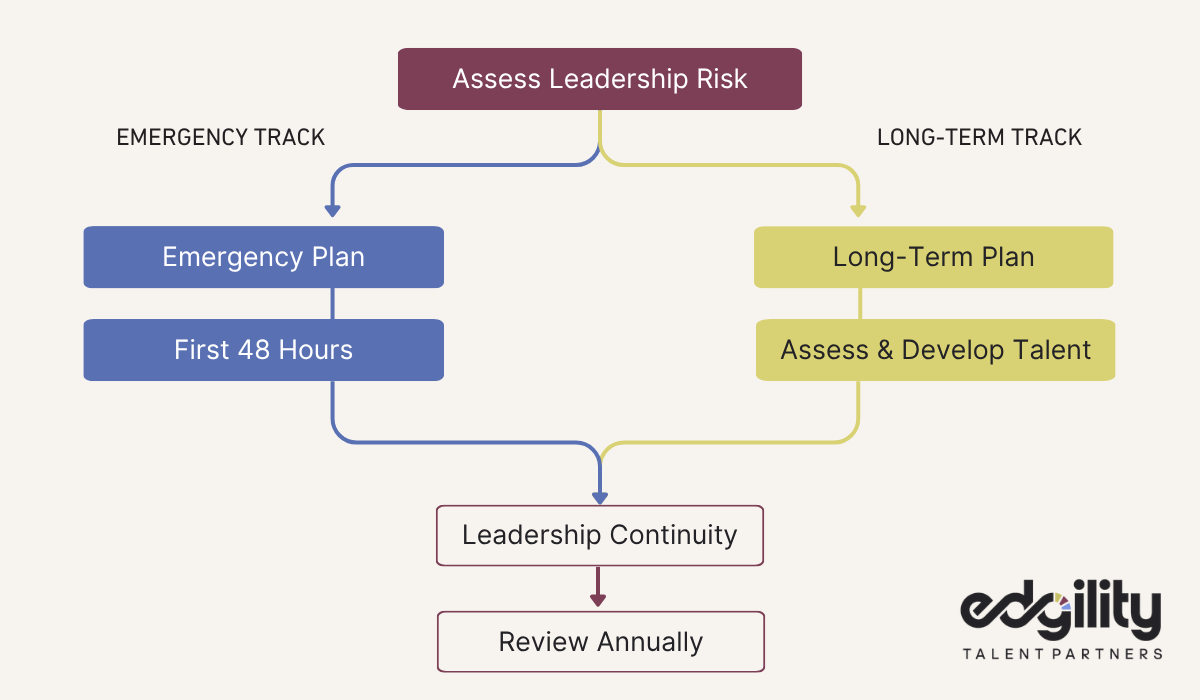
One common misconception about succession planning is that a single plan is enough. In reality, organizations need two.
The first is an immediate interim plan, often called an emergency succession plan. It outlines the steps the organization will take within the first 48 hours if an executive leader is unexpectedly unable to return, including who will step in to stabilize operations and communicate with staff, funders, and board members. The interim leader should be someone the staff trusts and who can maintain stability while the board determines its next steps. This person does not need to be the permanent successor. Their immediate role is to provide steady leadership and give the organization time to make a thoughtful, informed decision.
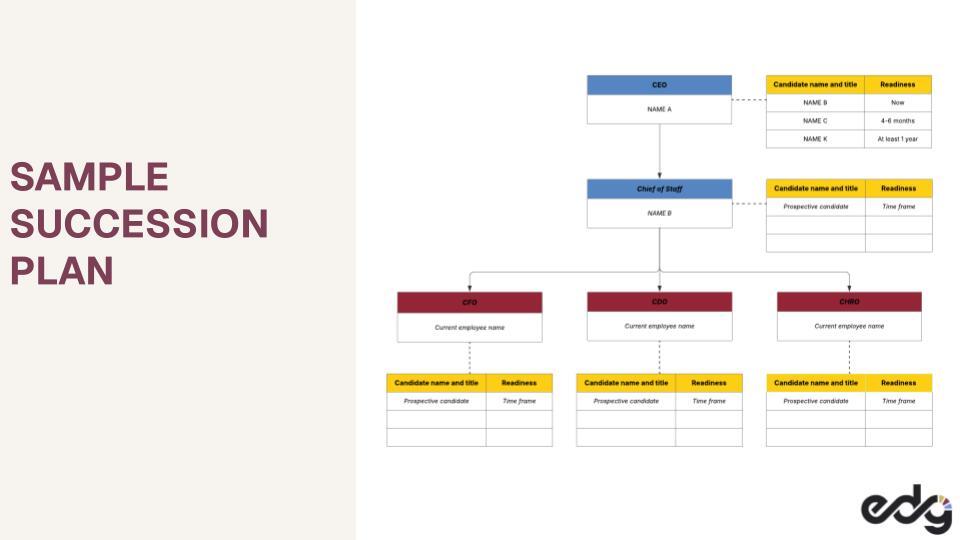
The second is a long-term succession plan that provides a clear view of the organization’s internal talent and readiness for a future leadership transition. It identifies potential internal candidates, assesses their development needs, and establishes a strong leadership pipeline. It should also prepare the organization for a potential external search by identifying search firms, selecting the search committee and its chair, determining a realistic compensation range, and ensuring the job description reflects the organization’s current needs. These details may seem minor, but addressing them in advance allows the board to make thoughtful decisions instead of scrambling under pressure.
When both plans are in place, boards can respond to a leadership transition with clarity rather than urgency. They have the information and processes needed to evaluate the situation, consider their options, and choose the path that best serves the organization.
It's also worth saying that different scenarios call for different responses. A planned departure like a retirement—where a CEO gives the board a year's notice—is the most manageable situation. The outgoing leader is still present to answer questions, help assess internal readiness, and participate in knowledge transfer. That's the best-case scenario, and it's where many succession planning projects begin. A performance-based transition is messier and more politically fraught, but it still requires the same infrastructure. And an unexpected or emergency departure? That's when having the CEO succession plan becomes the difference between a rough quarter and a multi-year recovery.
Why Nonprofit Boards Delay Succession Planning
What makes succession planning difficult is that it's strategic, long-range, and carries no visible immediate consequences if you skip it, which means it quietly moves to the next quarter, and then the quarter after that.
Boards are already navigating enormous complexity, from shifts in federal funding and major technology overhauls to financial uncertainty that evolves faster than most strategic plans can accommodate. Many board members are balancing these responsibilities alongside full-time jobs, making time and capacity significant barriers. Succession planning often remains on the list of priorities boards intend to address when more time and resources become available.
But the logic of "we'll get to it when things calm down" is precisely what leaves nonprofit organizations unprepared. The reality is that organizational demands rarely ease, and by the time a succession plan becomes necessary, it is already too late to create one thoughtfully.
There is also a cultural challenge beneath succession planning: organizations often struggle to discuss uncomfortable topics openly. Conversations about a leader’s potential departure, the possibility that a leader may need to be removed, or an unexpected tragedy require people to confront scenarios they would rather not consider. However, avoiding discomfort is not a governance strategy. Protecting the organization’s continuity and mission must take priority over short-term comfort.
How Succession Planning Strengthens Leadership Development and Retention
One reframe that tends to shift the conversation: succession planning doesn't have to be about replacing someone. Done well, it's about investing in everyone.
For executive directors and other senior staff, a talent assessment can feel understandably threatening. When a board begins considering who else in the organization may be ready to step up, executives may fear that decisions are being made behind their backs, their shortcomings are about to be exposed, or they are being evaluated for a role they already hold. That is why the board’s framing of succession planning is so important.
Positioning succession planning as an investment in staff growth can encourage more honest and constructive engagement. The process can uncover skills employees have not yet had the opportunity to develop and create meaningful pathways for people who are already doing strong work. That might include coaching, professional development, or a stretch assignment that addresses a critical organizational need. Succession planning may also reveal that someone’s strengths are better suited to a different role or that a person the board assumed was not ready is more prepared to step up than expected.
This approach also helps organizations rely less heavily on external hiring, which can be costly and carries significant risk. An executive search that brings in the wrong leader can have negative consequences that reverberate for years, including staff and funder departures, board resignations, and reputational damage. By intentionally developing talent from within, organizations can reduce those risks while creating meaningful professional growth opportunities that help retain strong employees.
Even when there is a strong internal candidate, the board should still assess that person against the external talent market. This does not necessarily require launching a full external search. Instead, the goal is to apply consistent criteria, understand the available talent landscape, and confirm that the internal candidate is the strongest choice. This kind of validation gives the incoming leader greater credibility and gives the organization confidence in its decision.
Executive Succession Planning Belongs on the Board’s Agenda
Planning for the succession of the CEO and other senior leaders is a core governance responsibility that safeguards organizational continuity and helps sustain long-term mission impact. It should remain a standing item on the board’s agenda, not a process initiated only when a senior leader departs, or a crisis occurs.
Every board should be able to answer a straightforward question: If the CEO, executive director, or another critical senior leader could not return to work tomorrow, would the organization know what to do? The board should understand who could step in, how decisions would be made, and how the organization would communicate stability to staff, funders, and partners. “We would figure it out” is not a plan. It is a hope.
Organizations that successfully navigate unexpected senior leadership transitions are the ones that prepared before the transition occurred.
Succession planning is much like creating a will. Few people enjoy considering why it may be needed, but when the moment arrives, they are grateful it is already in place.
Ready to Move From Awareness to Action?
If this conversation is one your board hasn't had yet, that's exactly where to start. Edgility Talent Partners has put together a practical guide for boards and senior leaders who are ready to move from awareness to action—Board Governance for Nonprofits: A Practical Guide to Executive Compensation, Performance Management, and Leadership Succession Planning. It covers the full picture: how to structure executive compensation, how to build a performance management process that actually works, and how to approach leadership development and succession planning before you need it. Read it, download it, share it with your board chair.

If your organization does not yet have a succession plan, now is the time to address it, before a leadership transition creates urgency. With support from an objective third party, your board can assess its readiness, identify leadership development gaps, and create a practical plan that provides clear options when change occurs.
Edgility Talent Partners guides mission-driven organizations through this process every day. Reach out to assess your organization’s current readiness and identify the next steps toward building a succession plan you can confidently put into action.



-1-2-1.png "Untitled design (20)-1-2-1")