



.png)
You’re building next year’s budget, and one line item keeps pulling more weight than it used to: salary increases. The data in this article reflects 2026 market conditions, but for many nonprofit organizations, those are the very signals informing FY27 pay decisions and how you show up in a competitive labor market for talent.
Staff are still feeling the aftereffects of several years of higher prices, even as inflation has begun to cool. At the same time, boards and executive teams are asking a different question: what can we responsibly sustain without falling behind the market or deepening existing inequities?
That is the tension shaping compensation planning right now. The volatility has eased, but the pressure has not disappeared.
Table of Contents
1. What the 2026 Data Is Telling You
2. Cost of Living vs. Cost of Labor
3. How to Set Your 2026 Increase Pool
4. Using Market Data the Right Way
5. The Essential Ingredients of Salary Planning
6. The Trends Underneath the Numbers
7. Keeping Equity at the Center
9. Build a Compensation System That Matches Your Values
What the 2026 Data Is Telling You
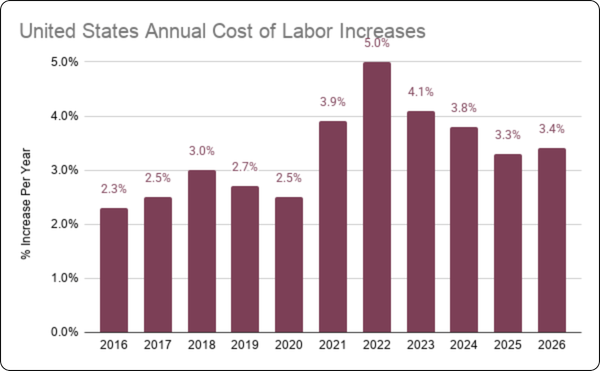
When we look at the latest data and salary surveys, we see a market that is no longer in the crisis posture you were navigating a few years ago. In the nonprofit sector, base pay increases were around 3.5% in 2025 and are expected to be about 3.7% in 2026—still higher than pre‑2020 norms, but far more stable than the spikes you’ve been reacting to.
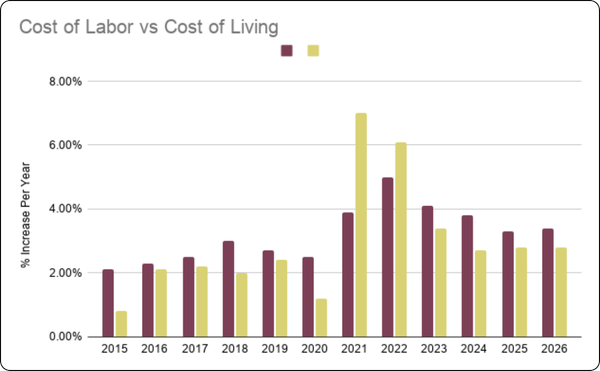
Before 2020, many organizations planned around 2.5% to 3% annual increases. That pattern was disrupted when the cost of living jumped by about 7% between 2020 and 2021—nearly triple what you might expect in a typical year. It has taken four years to move back toward “normal” levels.
That history matters because your people are still living with the aftereffects of that spike, even if the latest charts look calmer. Stabilization is not the same thing as relief. You may feel less panicked than you did two years ago, but your staff still sees the gap every time they pay rent or buy groceries.
The upside is that a less volatile market gives you space to step back from emergency responses and return to a more deliberate approach to compensation decisions.
Cost of Living vs. Cost of Labor
A lot of the confusion we hear from leaders stems from this simple question: Should you follow the cost of living or the cost of labor when setting annual increases? They are related, but they answer different questions. Treating them interchangeably can push you toward decisions that feel reactive instead of strategic.
- Cost of living reflects what it takes for your staff to live in a given place—housing, food, transportation, taxes, and other day‑to‑day expenses. It is more volatile, varies widely by geography and household circumstance, and tends to hit lower‑income workers hardest.
- Cost of labor reflects what employers in your market are actually paying to hire and retain talent for similar roles. Because it is typically less volatile and more closely tied to the labor market, this is what most strong compensation programs use to set salary structures, pay ranges, and annual increases.
You need both lenses. Cost-of-living data helps you understand the real pressure your employees are feeling. The cost of labor gives you a steadier guide to what it will take to stay competitive—and financially sustainable—over time.
As we look over the last few years, there’s a pattern we see: the cost of living drives the sharp spikes up and down, while the cost of labor lags and smooths those swings. Anchoring your annual increases to the cost of labor is what helps you move back toward equilibrium without committing to raises you can’t afford to sustain.
“Cost of living is what drives it up and down, but cost of labor is less volatile, which is why we encourage organizations to use it for annual increases.”
 How to Set Your 2026 Increase Pool
Once you have that context, the question becomes very practical: how much should you actually budget for salary increases this year? The short answer is that most nonprofits will land somewhere in the 3 – 3.7% range, but where you land in that band depends on how you’ve handled the last several years and how your current pay compares to benchmarks for a truly competitive salary in your markets.
Here’s how we suggest you think about it:
-
If you’ve been giving less than 4–5% in recent years
You’re probably behind both market movement and what your staff has experienced in their personal budgets. This is a year to consider budgeting above 3.7% so you can start catching up deliberately rather than inching along. -
If you’ve largely kept pace with cost‑of‑labor increases (around 4–5%)
You can likely plan for a pool around 3.5% and remain competitive, especially if you are thoughtful about how you allocate that pool across roles and equity priorities.
-
If you’ve been making unusually large increases
You may be ahead of many peers and already offering higher salaries than similar organizations. In that case, you might have room to come in around 3% this year without compromising your position in the market.
The point is not to hit one “magic” number; it is to choose a pool that makes sense given where your pay has been, where the market is going, and what you can sustain—then to use that pool in ways that are transparent and equity‑minded.
Using Market Data the Right Way
One of the simplest ways you can strengthen your salary decisions is by relying on more than a single market number or headline. In our fireside chat on year‑end planning, we emphasized a basic rule: use at least three recent, relevant data sources when you plan annual increases.
That means looking at:
- current inflation and cost‑of‑living data
- current cost‑of‑labor data
- salary surveys and salary budget surveys from reputable providers (Payscale, Mercer, WorldatWork, and others)
You also want those sources to be specific to your sector, geography, and organizational size, and recent enough to reflect what’s happening now. Otherwise, you risk anchoring your decisions on stale or misleading information. As we like to say: bad data leads to bad decisions, especially when every compensation choice carries real implications for equity, retention, and financial health.
Using multiple data points will not make the decision for you, but it will give you a stronger foundation for your judgment and a clearer story to bring to your board, managers, and staff.
The Essential Ingredients of Salary Planning
Annual increases don’t live in a vacuum. When we support organizations through salary planning, we always start by asking about the system around the numbers and the overall compensation package you’re offering.
There are six essential ingredients for annual salary planning:
- A clear compensation philosophy
- Up‑to‑date market compensation data
- Local cost‑of‑living information
- Performance data, if you’re using merit increases
- Local cost‑of‑labor trends
- Wage‑gap analysis (regression or observational) to surface inequities
When one of these is missing—especially your philosophy, good market data, or equity analysis—you’re more likely to end up with pay decisions that feel inconsistent, reactive, or hard to explain.
This is also where you can see Edgility Talent Partners’ core stance come through: a healthy compensation system is externally competitive, internally equitable, and financially sustainable, and it aligns with your strategy and compliance requirements. Your annual increase decision is just one expression of that system.
The Trends Underneath the Numbers
Beyond the percentages, there are real shifts in how nonprofits are approaching compensation and benefits in this “cooling but still costly” moment. Across our client work, we’re seeing several patterns show up again and again.
Living-wage floors
More organizations are setting explicit living‑wage floors tied to the local cost of living, so no one sits below a true living‑wage threshold, then building ranges above that while staying anchored in market data. At the same time, leaders are using living‑wage modeling to make more intentional, values‑aligned tradeoffs in their structures—prioritizing the lowest‑paid roles and revisiting how dollars are distributed across the organization, rather than assuming “the market” alone will lead to equitable outcomes.
Read more about this topic, Living Wage: What It Is and Why It Matters for Mission-Driven Organizations, to explore how compensation decisions impact retention, trust, organizational culture, and long-term mission alignment—and why a living wage conversation is about far more than numbers alone.
If you "can’t do more, do better” on equity
Many leaders don’t expect to be able to offer big increases for the next few years. Instead, they’re doubling down on pay transparency, fairness, and structural equity—so even if you aren’t doing more in terms of percentages, you are doing compensation better, in ways staff can actually see and feel in how ranges are set, how promotions work, and how questions about pay get answered.
Career growth as a retention lever
With budgets constrained, you may not be able to solve everything through salary alone. We’re seeing organizations invest more in career pathways, competency models, and professional development opportunities that don’t always require large salary adjustments but do show staff that they are valued and have a future with you. If your increase pool is modest, you still have to give people a reason to stay.
From Chaos to Structure
For many organizations, the old pattern really was chaotic: compensation drifted until a crisis hit, everything got fixed in a rush, and then it drifted again until the next crisis. That approach is becoming harder to defend in an environment where salary range posting requirements and employee expectations are both rising. Instead, you and your peers are building clearer pay range architecture and running regular equity analyses as a baseline expectation, not a special project.
Benefits under pressure
Benefit costs continue to rise, and it is still hard to offer rich packages in a resource‑constrained environment. That pressure is pushing organizations to be more creative about benefit design, flexibility, and communicating the value of the overall compensation package they do provide
Mergers as a sustainability strategy
We’re also seeing more nonprofits exploring mergers and deeper collaborations, as questions about financial sustainability drive not just pay decisions but also structural ones about how to keep missions viable for the long term.
Taken one by one, these trends can feel a little scattershot. But together, they tell a clear story about where nonprofit compensation is headed: fewer dramatic changes, more pressure on sustainability, and more attention to structure, transparency, and steadiness.
In many ways, it’s a “steady as it goes, batten‑down‑the‑hatches” season for compensation—less about dramatic course corrections, more about staying upright in choppy but no‑longer‑stormy waters.
Keeping Equity at the Center
It’s tempting to treat equity as something you’ll come back to when you have bigger pools to work with, but the reality we see is that equity matters just as much—and in some ways more—when increases are modest.
When there isn’t much money to move around, every decision about who gets what raise carries more weight. Without clear structures, smaller pools tend to be distributed based on who asks, who is most visible, or who already has more power in your organization. Over time, that quiet pattern can widen the very gaps you’re trying to close.
This is why we encourage organizations to pair their increase decisions with the structural pieces that make equity real: transparent pay ranges that show people where they sit, clear criteria for how increases are determined, regular equity and wage‑gap analysis to surface patterns, and a commitment to living‑wage floors wherever you can reasonably sustain them. Those are the foundations of meaningful pay transparency in practice.
When you put those elements in place, you reduce the amount of individual discretion that can slowly re‑create inequity over time, even when your overall budget is constrained.
“Even if you’re not doing more, you can still be doing better—through transparency, fairness, and equity.”
What You Can Do Next
As you move into FY27 planning, you don’t need to have every answer. But you do need a clear, defensible story about how you set your salary increase pool, how you’re using it, and how it connects to your broader compensation strategy.
A practical path forward might look like this:
- Look back at your last 3–4 years of increases. Did you keep pace with cost of labor, fall behind, or jump ahead?
- Review three kinds of current data. Local cost of living, cost of labor, and recent salary budget surveys relevant to your sector and size.
- Choose an increase pool in the 3–3.7% range that matches your reality. Go higher if you’re catching up, closer to the middle if you’ve kept pace, and slightly lower only if you know you’re ahead.
- Strengthen the structure around that pool. Make sure your philosophy, ranges, equity analysis, and communication plan are strong enough to carry you through a period of modest increases.
- Name the tradeoffs out loud. Bring your board and staff into a transparent conversation about how you’re balancing market competitiveness, equity, and financial sustainability this year.
As you do this work, you don’t have to navigate alone. At Edgility Talent Partners, we sit alongside leaders like you to bring objective data, structured processes, and an equity lens to decisions that are both financially consequential and deeply human. The goal isn’t to chase every headline. It’s to make pay decisions you can explain, defend, and sustain—for your people and for your mission.
Go Deeper: Build a Compensation System That Matches Your Values
If reading this has you thinking, “Our salary increase decision is only one piece of a much bigger puzzle,” you’re exactly right. Annual pay planning is hard to get right when the underlying structure, philosophy, and equity practices are shaky.
If you want support thinking beyond this year’s percentage to the systems that make compensation fair, transparent, and sustainable—from frontline roles to executive pay—Compensation with Purpose: Designing Equity-Centered Pay Structures for Nonprofits, Education, and Healthcare is a good next step. In it, we walk through the most common compensation traps organizations fall into, why reactive and “hidden” pay systems erode trust, and how to design a structure that truly aligns with your values, budget, and people.
You don’t have to fix all of this at once. But you do deserve a roadmap. This eBook is designed to help you move from one‑off salary decisions to a compensation approach that gives your staff clarity, gives your board confidence that you’re offering competitive salaries and benefits, and gives you a structure you can grow on—year after year.





-1-2-1.png "Untitled design (20)-1-2-1")